Enterprise
Storage
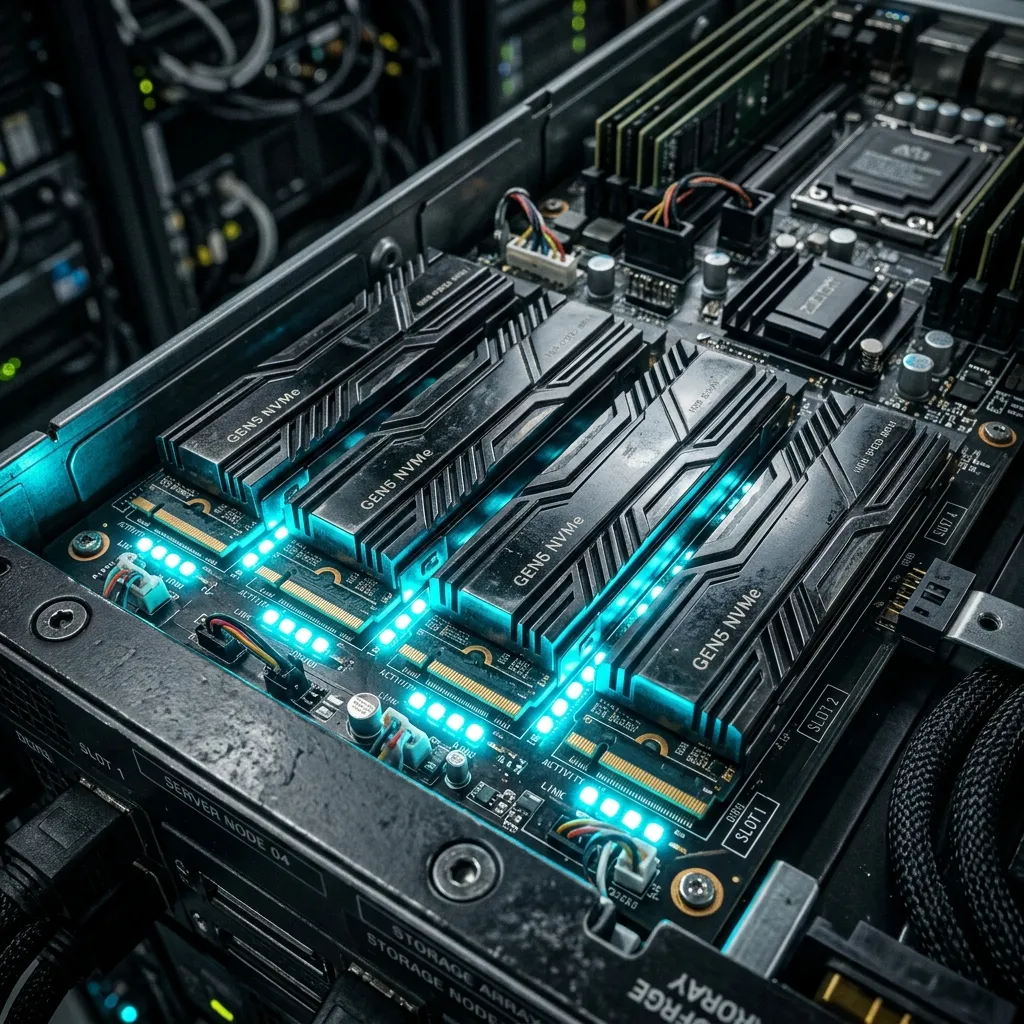
Eliminate I/O bottlenecks. Our massive NVMe Gen5 SSD arrays deliver millions of IOPS to ensure your databases and game worlds load instantly.
Speed Meets Durability.
In modern cloud environments, the CPU is rarely the bottleneck-it's the disk. Legacy spinning drives and even standard SATA SSDs cannot keep up with the I/O demands of enterprise databases or massive multiplayer game worlds. Plex Scale strictly utilizes PCIe Gen5 NVMe arrays configured in highly redundant RAID topologies. We treat your data as if it were our own.
Technical Specifications
Bypassing The Bottleneck
Unlike traditional storage that communicates through legacy SATA or SAS controllers, our Non-Volatile Memory Express (NVMe) drives attach directly to the motherboard's PCIe Gen5 lanes. This direct connection to the CPU bypasses the traditional storage stack entirely, slashing latency from milliseconds to microseconds.
However, raw speed is useless without data integrity. All Plex Scale storage arrays are formatted using the ZFS file system. ZFS provides copy-on-write functionality, meaning data is never overwritten in place-preventing corruption during sudden power loss. Furthermore, ZFS performs continuous background checksumming.
If a single bit flips due to cosmic radiation or silicon degradation, ZFS instantly detects it and repairs the block using the redundant parity data in the RAID array, all completely invisible to your running applications.
Zero Data Loss Architecture
Triple-replicated block storage ensuring your data survives hardware failure.

Protecting What Matters
Self-Healing Arrays
Automatic block-level corruption detection and repair.
High IOPS
Sustain millions of Input/Output Operations Per Second for massive databases.
Automated Snapshots
Instantly capture the state of your drive before updates, deploy in seconds.
Where I/O Matters Most
Plex Scale vs Others
| Feature | Plex Scale | Other Hosts |
|---|---|---|
| Storage Medium | PCIe Gen5 NVMe | SATA SSD / HDD |
| File System | ZFS (Self-Healing) | ext4 / NTFS |
| Array Topology | Hardware/ZFS RAID 10 | RAID 0 or No RAID |
| IOPS Capability | 1,000,000+ | 10,000 - 50,000 |
Common Questions
Is the storage local or network-attached?
What is RAID 10?
Are backups included?
Can I add block storage later?
Stop Waiting on Disk
Deploy your database on Plex Scale Gen5 NVMe arrays today.
24-hours money-back guarantee. No credit card required.